The case for smaller models in AI vulnerability research
In October 2026 an AI security company called XBOW used around $40,000 in compute power over 6 days to create a three-vulnerability Chrome exploit chain and was awarded $250,000 by Google. To achieve this, they used GPT-5.6 Sol agents along with their own security harness. [1]
It is an impressive result, and part of a much larger change inside vulnerability research. Anthropic has described Claude Mythos finding and exploiting unknown operating-system vulnerabilities, including a remote-code-execution flaw in FreeBSD's NFS server previously. The Google Chrome development team has also reported vulnerabilities found by AI in V8 and the graphics stack, including a sandbox escape that had survived more than thirteen years. [2] [3]
Mass findings are now emerging in mature codebases, and AI agents are helping researchers move from something that may sound suspicious to something they can reproduce and weaponise.
There is, however, another question worth asking: how much of this ability actually needs the most powerful model available?
XBOW's result shows what a skilled researcher and frontier-model agents can accomplish together. It does not tell us what bare minimum resources are needed to perform this level of research.
How much comes from the model?
To understand why smaller models have a role, it's best to look at what an AI research system actually does.
In a standard vulnerability research workflow, reading the target codebase is only part of the process. A researcher who has found a point of interest in the code will then establish how it is reached, which assumptions it violates, and what happens when those assumptions fail. Much of the process consists of testing an idea, discovering that some detail was wrong, and using that result to decide where to look next.
An LLM performing research does this using the tools and information available to it. A debugger provides evidence about execution. A test rules out an imagined failure. Documentation explains the security boundary the code is supposed to enforce. The surrounding software (the harness/scaffolding) organises those interactions as well as helps the scan make progress.
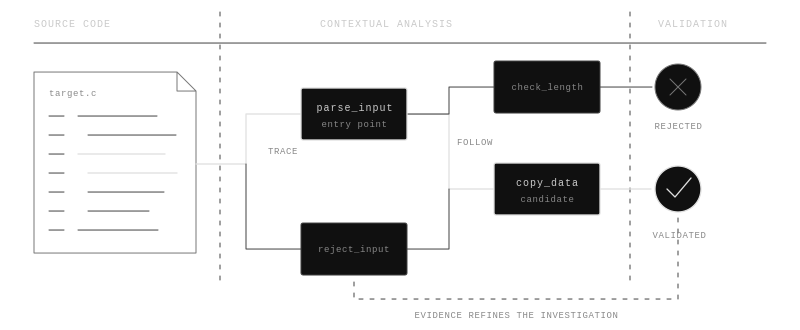
This is why the identity of the model tells us only part of the story. OpenAI's Codex Security, for example, combines frontier reasoning with a project-specific threat model, validation and proposed fixes. Google's Chrome workflow incorporates project knowledge, critic agents, and repeated investigations. These are research systems whose behaviour depends on how their parts work together. [4] [3]
The contribution of the model can be substantial. Anthropic described a relatively simple scaffold for its Mythos experiments, permitting the model to investigate inside an isolated target environment. Strong reasoning can clearly take a system a long way. What remains open is how much reasoning capability a particular investigation needs, and whether a different system could reach a useful result with less. [2]
To put it one way: If the scaffolding is so good, why do we still need Opus? The answer may be that some tasks benefit enormously from it. But that is a reason to understand where the benefit comes from, rather than assume the same model is necessary throughout every workflow.
The evidence already suggests that this is a productive direction. AISLE describes its approach as "system over model", combining models, including custom fine-tuned ones, with context, validation, and human review. In October, the company reported discovering eighteen of the 24 vulnerabilities fixed in curl 8.23.0. [5]
Those results do not say that smaller models are comparable to larger models, but they do make the whole research system more of a useful comparison. It then becomes a question of what it finds, how reliably it finds it, and what resources are needed to get there.
Bringing the research onto local hardware
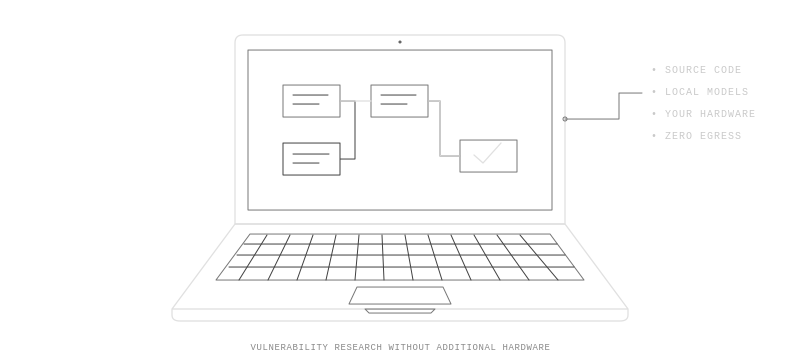
At Oculytic, we are approaching that question from the resource-constrained end. Our work explores vulnerability discovery using smaller models running locally on laptops, with the aim of making meaningful research practical on ordinary hardware.
This means that instead of starting with the strongest available model for security and asking how far we can push it, we begin with a tighter resource budget and ask how we can achieve similar results with that: preserve the parts of the scan that produce valid results while reducing the infrastructure needed to carry out the scan.
FreeBSD provides one concrete example of our contribution. On 16 June, the project committed a fix for an overflow in the packet-filling logic of the ping6 utility. [6]
The goal was to explore codebases others had already explored to establish a baseline comparison against other systems in the same field. AISLE's May disclosure described separate overflows involving descriptor-set handling in the same program and related FreeBSD code. This does not establish that AISLE examined it and missed it, but it shows why another scan can continue to be valuable even after a prominent research effort. This is perhaps strengthened by the fact that the ping6 program itself is rather small. [7]
Others share the ambition to run research locally. AISLE offers on-premises and air-gapped deployment, while Dream describes its Hercules and Hero system running on local NVIDIA infrastructure without external API calls. [5] [8]
That makes the hardware requirement a particularly important distinction. Moving a model from an external service to an organisation's own GPU server offers control over where inference happens. Reducing the requirement further could bring useful research within reach of teams that have no dedicated inference infrastructure at all.
A laptop is a meaningful target because it makes that ambition concrete. The full workflow must be practical, and analysis of the target software must work on constrained resources. This means that, from our perspective, fitting a model into memory is one part of the solution.
What efficiency would change
Economics
The cost is the most obvious thing that comes to mind. A smaller local system producing real findings means that a team using it may be able to scan more within the same budget. This is paramount when it comes to continuous workflows where the cost of each scan accumulates across repositories, revisions, and unsuccessful attempts.
However, it's important to note that smaller does not automatically mean cheaper. A weak model that repeatedly loses its way can consume more time and effort than a stronger model that completes the scan quickly, especially since someone still has to validate the output.
A better comparison is the total effort required to produce an actionable finding. This should include failed runs, retries, and human review, alongside the cost of the compute used in the successful attempt. A system that produces fewer reports but requires much less triage offers more value than one that generates a long list of possibilities.
That is also why discovery counts and benchmark scores need context. Reproducing a known vulnerability from a supplied description tests a useful capability, but it differs from searching for an unknown flaw. DARKNAVY's DoGNAVY report, for example, pairs its CyberGym reproduction results with explicit resource accounting. That kind of reporting helps us understand the work performed and the cost attached to it. [9]
Comparisons then become much more informative. Target revisions, validated findings, time to result, hardware requirements, and any required human assistance makes it possible to link performance to an actual decision a security team must make.
Privacy and Security
In some environments, that decision begins with where the research can run.
Source code and unpublished vulnerabilities can be sensitive enough that an organisation requires them to remain inside infrastructure it controls. A locally operated system lets it investigate that software without sending code or intermediate analysis to an external provider, where it could be leaked to another user (as may have been the case with the Navier–Stokes priority controversy). A fully offline workflow must extend that independence to its build tools, dependencies, and validation environment as well.
This makes efficiency relevant to sovereignty as well as cost. For the UK, a practical route towards greater independence might be to combine security research expertise with locally operated models and infrastructure. That capability need not begin with building a domestic frontier foundation model. It can begin with making effective use of models that organisations can run and maintain themselves.
This is why the smaller-model question deserves attention, even as frontier models improve, and the answer is that the two directions go hand-in-hand: stronger models expand the range of possible research, while more efficient systems bring the useful parts into the hands of those that need them.
The achievements of XBOW, Anthropic, Google, and others have made the potential of AI vulnerability research much harder to dismiss. They have also given the field something worth making more widely available. At Oculytic, we're interested in how far we can take that capability while reducing the resources and external dependencies it requires.
The next breakthrough may arrive as a more powerful model. It may also arrive when a small security team can perform useful vulnerability research on the hardware already sitting on their desk.